


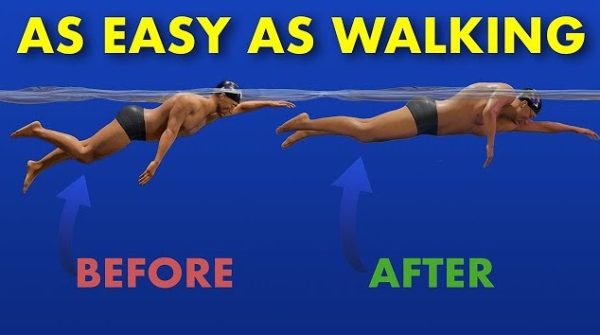
You can walk without getting tired, so swimming at a slow pace can be almost as easy as walking.
Chloe McCardel swam for 41 hours and 21 minutes (124.4 km or 77.3 miles) nonstop in the ocean. Veljko Rogošić swam 50 hours. Sarah Thomas for 54 hours. Ricardo Hoffman for 84.5 hours in a river. With the 10 steps I’m about to explain to you, you can surely swim for an hour and a half without getting tired.
You have to know that swimming without getting tired is about mastering two skills.
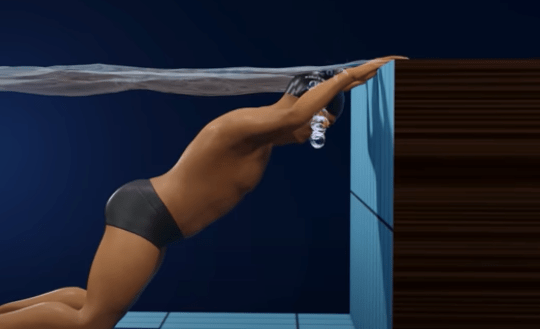
Two Key Skills
- Glide through the water without much resistance
- Anchor your hands to move forward.
Those are two sensations that you have when you are swimming correctly. If you’re just starting out, there are a few things you need to focus on before you feel the glide and anchor.
Step by Step Swimming More Efficiently
1- The first thing you should learn is to keep calm with your face underwater.
It’s very common to panic when your face is underwater and you can’t reach the ground. It’s impossible to swim relaxed if your heart starts beating faster just from being underwater.
That’s the first gliding feeling you’ll have.
2- The number one enemy of a beginner swimmer is the legs.
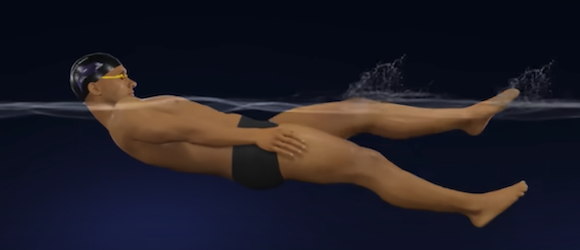
If I could offer you one piece of advice, it would be to do this exercise many times. Kick on your back while looking at your feet, trying to create turbulence only in the feet and not in the knees.
The more you do this exercise, the better your legs will float near the surface when you swim freestyle.
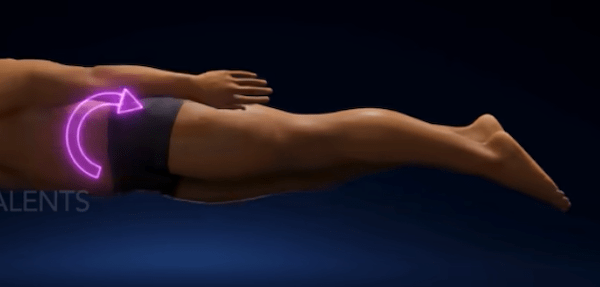
3- Twisting your torso and gliding sideways is good for your shoulders and swimming technique. The rotation of your shoulders helps increase the speed of your arms.
Your arms are what move you in a long-distance swim. The legs also help. But the kick is important because it also provides stability, balance, and buoyancy. That is if the legs are fairly straight and the kick is fast and small.
4- Because of their shape and speed, the hands create pressure in the water.
You can use that pressure to anchor your hands. Your arms are the levers that move your body forward. After mastering this step, you have pretty much learned how to swim. From now on things get more difficult and progress is going to be slower. You need to find a purpose to keep improving or you will most likely give up and never feel how amazing it is to swim without much effort.
When we asked our audience, they said they swim for physical fitness, to feed the competitive spirit, for mental health, and for the friendships they built, and half of them said all of the above! 85% said that their lives are better because they know how to swim.

5- Breathing correctly is the most important thing if you want to stay calm. Swimming in the sea is more chaotic than swimming in a pool. Specially if you are swimming with less than 4 people in the lane. But in the sea, it is more important to remain calm because the shore and the lifeguards are further away.
One way to control your breathing is to increase your tolerance to CO2. You can increase it by breathing every 3 strokes. Then 4, then 5, and work your way up to 10. If you can breathe every 10 strokes while staying calm, you’re one step closer to being calmer in the water and in life.

6- Rotator cuff tendinitis is the most common injury in swimming.
This can keep you out of the pool for months. To avoid that, the next exercise is the most important you can do. You can do it without any resistance at first. Then, you can use a rubber band like the next one or a smaller one to make sure you don’t move your elbow. I do this for 20 reps on each side before hitting the water.
The other thing you can do to keep your shoulders healthy is to know which technique feels most natural for your level of shoulder mobility. The best swimmers turn the shoulder internally when the hand is still in front. That is not possible for everyone. Starting the pull a little more open is also a great way to swim, as long as your palm is facing backward.
This will make your stroke move slightly in an S. But don’t overdo it by pushing your hand palm toward the wall. That will make you swim in ZIGzag.

7- The shrug. The two main muscles that will make you pull your arm faster are the pecs and the lats.
The more you stretch them, the longer and more powerful your stroke will be. So, at the start of the stroke, think about stretching those muscles by pushing your shoulder down near your cheek while the elbow remains close to the surface. If you are able to feel that, you will be able to increase your speed much more.
Although that can be a little more demanding.

8- The last step to make your freestyle look beautiful is a clean entry. We already talked about how to do it, but I forgot a very important piece of advice:
There needs to be a good shoulder rotation at the same time the hand enters the water so that it slides like a knife through butter.
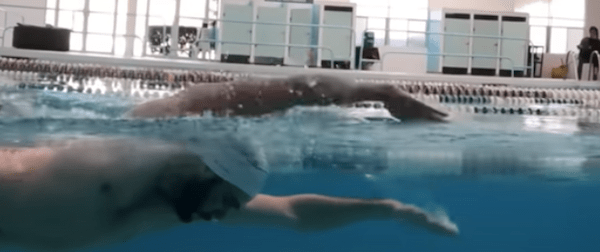
Someone commented on a video that our videos make freestyle look impossible to swim properly. In a way, no one in the world swims perfectly. But swimming perfectly like an animation was never the goal.
The best thing we can do to make swimming as easy as walking is for our body not to cause excess drag. And then to increase the strength and endurance of our pulling muscles.
In open-water swimming, the most important thing to learn is to remain calm. In the ocean, it is very difficult to know if you are moving forward or not. Having people around you helps. But staying calm and maintaining good technique was the key to success.

Tell us how it works for you!
Thank you!