


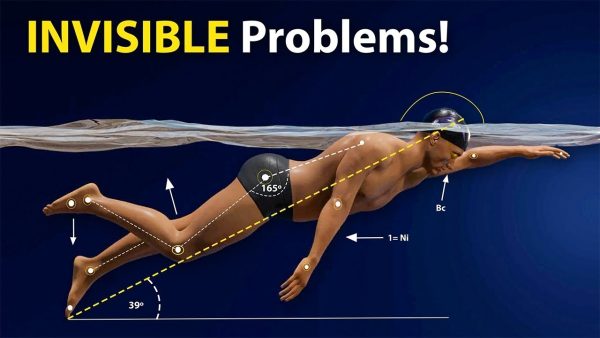
The next blog will save you a lot of time and frustration. We will share with you what we have learned these last 5 years of research and in more than 20 years of swimming experience that my brother and I each have.
We are going to give you the example of Aaron. He is good at every sport, especially running and cycling. But when he goes into the pool, he gets tired fast. This is a problem because, in 5 months, he will do an Ironman competition.
The competition begins with a 2.5-mile swim (3.86 km swim), and Aaron cannot swim more than 100 meters without stopping.
Our goal is to help him swim without getting tired. Right now he has several problems. He is fighting the water, we are not going to fix it immediately, but we will take him through the shortest way to success.
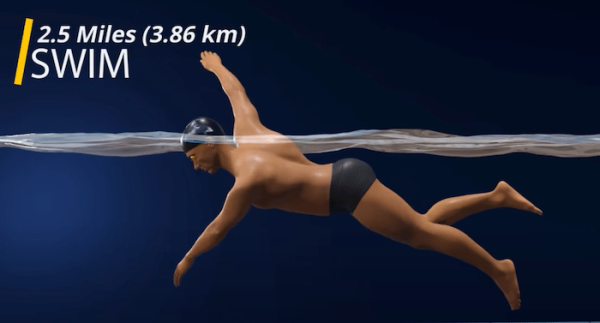
It’s tempting to tell him not to cross his arms when swimming or to bend his elbows. Even the most detail-oriented of you will tell him not to bend the knees so much. But that won’t help. We have to start with the solutions to the biggest problems that will benefit him the most in the least amount of time.
Hidden Problems
The first thing we have to do is tell Aaron to push himself off the wall. This way, we remove complexity and discover basic things.
These types of exercises help all levels of swimming. So don’t feel that if you are more advanced than Aaron, this won’t help you. He does not have a good sense of horizontal balance. He doesn’t even have a small amount of CO2 tolerance.
These two things make him anxious, so he moves his legs a lot, and his heart rate increases as he tries to move in the water. The challenge of swimming smoothly is lost in the first 5 meters.

Let’s start with tolerance to excess CO2. When you are taught to swim as an adult, it is incorrectly assumed that this concept is already mastered. In reality, the fear of excess CO2 in your lungs is one of the most primitive and powerful instincts we have. You can lose the function of the amygdala, the part of the brain responsible for fear, and your brain will still freak out if it detects excess CO2.
With any stressful situation, such as getting into a very cold shower, the first thing you instinctively do is to inhale more frequently to get more oxygen. But that’s a conversation for much later. For now, we can help decrease that reflex with a simple exercise.
The Magic of Bubbling
It all starts with bubbling. It consists of taking air and blowing it slowly through the nose under the water. This is very easy for Aaron, so we increase the difficulty by telling him to hold his breath for ten seconds before releasing the air slowly through his nose. After a couple of tries, Aaron succeeds. The next thing is to hold the breath for 15 seconds and blow the air through the nose for at least 5 seconds. If it becomes too easy, let him do it 5 times, taking one breath before putting his head back in.
After this exercise, Aaron feels calmer in the water.
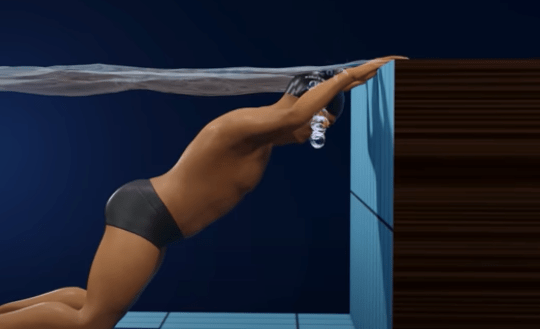
We go back to pushing from the wall as far as he can. We see that he still doesn’t have horizontal balance, but at least he holds his head underwater longer.
If you have the same problem as Aaron, you don’t pull your chest deep enough, and your body is at the wrong angle when you push. First, you must go under and then push. You have to use your arms to sink in, but overcorrect and push down toward the ground. If you struggle to rise to the surface and panic, back to the bubbling.
Now that you are calm, you can try to adjust the angle. The problem is that your feet rise to the surface before you push. There should be a straight line passing through your feet, hips, and hands, parallel to the ground. Now, if you push yourself properly, you can push harder until your feet pass the 5-meter mark.

Time to Swim
After Aaron does 3 pushes from the wall until his feet pass the flags. Now it’s time to swim.
Aaron tries to do 25 meters of smooth swimming, but we have to stop him again. He pushes off well and can take more strokes without breathing, but his knees keep sinking. Now we put a pull buoy between the knees.
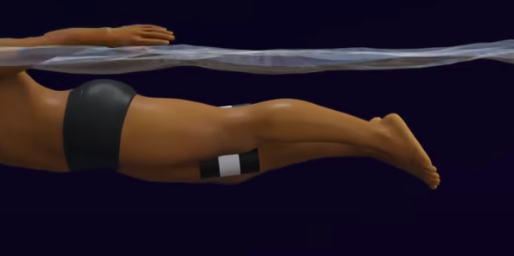
Why Pull buoy?
We do this for two reasons:
- To get his knees up
- To stop him from moving his legs too much.
Although we already told Aaron that he does not need to move his legs as much to move forward and he understood, his body wants to keep moving them instinctively. So with the pull buoy between the knees, he is creating the muscle memory to tell his body that he can swim without having to move his legs.
He does 4 x 25s that way. He leaves the pull buoy and tries to swim without moving his legs as much. A little better at first, but he quickly goes back to the same thing. Obviously, muscle memory is not created that quickly.
Now we take the exercise to the next level of difficulty. The pull buoy between the feet. This helps him tighten his feet, but he cannot keep it in place. He tries it several times until he succeeds. As you can see, Aaron doesn’t give up without a good fight.
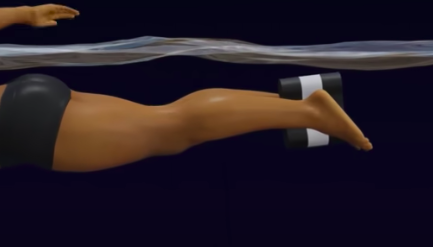
If you try to swim freestyle again after using the pull, maybe you will notice that now it is worse than before. Your feet are gonna be uncoordinated, and sank.
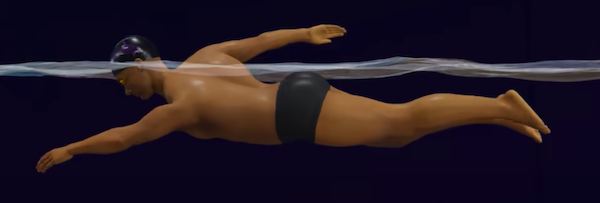
So you must go back to the wall and push and just do three strokes without breathing. This time you are gonna keep the legs high in the water.
Why? The same thing happens on a bicycle. When you go faster, it is easier to keep your balance. Since Aaron has enough speed when pushing off the wall, he manages to keep the balance for a few seconds. You can take the opportunity to take three strokes without breathing.
You have to start stroke by stroke; do 5, 6, and up to 7 strokes without breathing after the push. This begins to give you the feeling of moving through the water in a good position.
The Next Step
Now it’s time to teach Aaron the correct breathing technique while swimming.
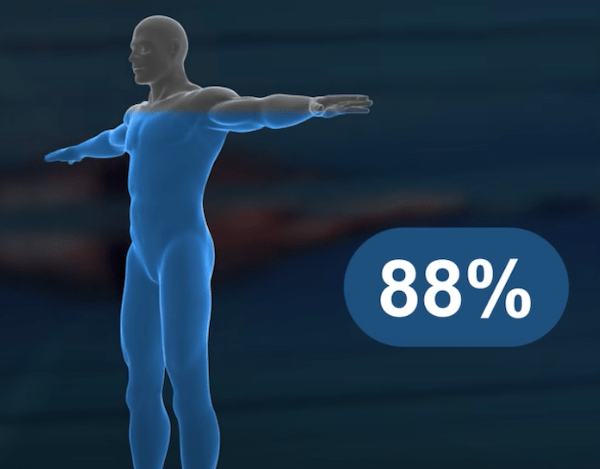
88% of the body weight in freestyle is underwater at all times. Keeping that 12% of your body weight above while keeping the rest of your body close to the surface is quite difficult.
With the whole head out the percentage increases from 12% to 16.5% approximately. This means that it is 35% more difficult to swim breathing with the whole head out than with only half the head out.
Aaron’s problem is that in his mind he has the image of elite swimmers swimming above the surface.
It is true that they get to a speed that allows them to be more above the surface, but even they have most of their body underwater. For an Ironman long-distance swim, it is not the speed or the technique that we want to achieve. It is best to find the most efficient way to swim through the water and not above it.
To correct Aaron’s breathing we tell him to keep half of his face in the water when he breathes.
But there is a gap between the words he understands and what his body is used to doing. And if you give the body a choice, it will always do what is familiar.
Improving
If you want to improve your breathing and your balance, side kick is one of the best exercises to achieve it.
The problem now is not the horizontal balance, but to keep the balance on the side of the body. It’s not easy either to stay close to the surface while on your side.
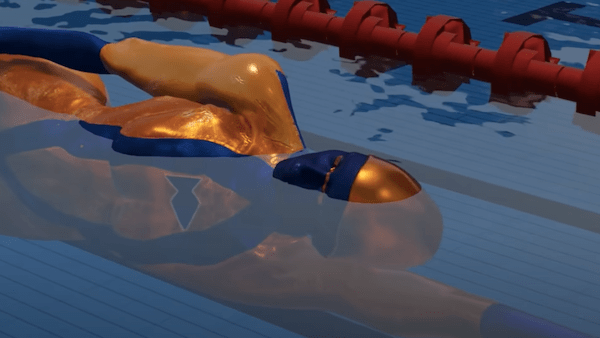
We will first have to correct that kick before we can correct the breath. The kick starts at the hip and the movement goes through the leg to the toes like a whip.
The hips make the knee sink a little, then the foot, and the tip of the whip are the toes. Then, the whole leg goes up extended. While one leg goes down the other goes up.

Experiment with it and share your experience!
Thank you!