


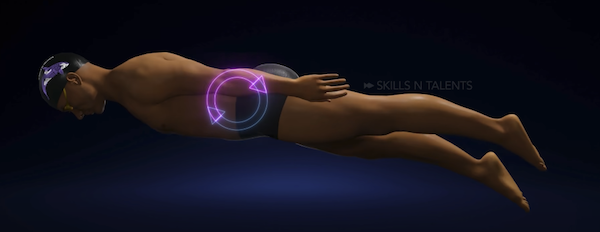
The body’s rotation is easy to do, but many people don’t know there is a short pause. This pause makes you swim way faster. The energy transfer between arms and legs is what makes you move well in the water. It doesn’t matter if you use your legs a lot or a little.
Many call that transfer of energy body rotation. But if you look at it in detail, the whole body doesn’t rotate at the same time or to the same degree. Doing that is a big mistake.
Where does Rotation Come From?
We will analyze it in detail and simplify the concepts with practical exercises.
The legs are connected to the torso at the hip joint and the arms at the shoulders. The connection between the shoulders and the hips are the vertebrae and the rib cage.
The bones by themselves do not move, the muscles that connect the bones are what move everything. For the purposes of this blog, it is not necessary to learn or understand all the muscles that connect the arms and legs to the torso. Your body is much smarter in that regard. If I tell you, to raise your elbow, you don’t need to know which muscles to use.
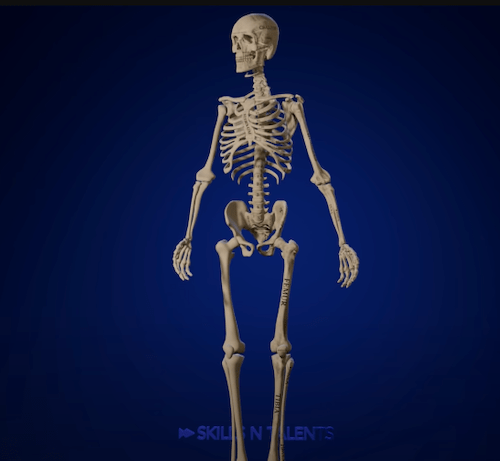
We will only focus on the bones and your body will take care of the rest. As we mentioned before, the hips move from side to side. In long distances, it rotates more than in short distances.
Hip Rotation
The hip rotates to its maximum point when the arm on the same side is fully stretched. It stays in that position during gliding and hand positioning.
It begins to rotate to the other side until the arm begins the propulsion phase, and it finishes rotating when the arm finishes the stroke. The kick assists in the rotation of the hip.
For the energy to not be lost at the hips, the core muscles are activated so that the shoulders rotate as well. That is why the hips begin to rotate a fraction of a second before the shoulders. The shoulders also rotate with the help of the arm that ends the stroke and the weight of the other arm in front.
In our camps, it is common to see a good rotation. What is not very common is the correct timing of the rotation.
The Best Example
Aaron has been swimming for one month and has already learned to have horizontal balance and relax a little more in the water, but still looks a bit tense. That’s because the hips and shoulders don’t stay in rotation long enough.
If we divide the time it takes to rotate the hips into four equal parts it would look like this:
– one-fourth remains in the rotation
– one-fourth is rotating
– one-fourth remains in the other rotation
– and last quarter returns to the starting position.
Aaron only rotates half the time and the other half is rotating the other way. To solve this problem, he must do two things: stay longer on your side and rotate faster.

There are two mini skills that he needs to learn: glide with the arm in front and slow down the beginning of the stroke.
Aaron is still not ready to correct the stroke, so we can tell him to glide more. But it is easier said than done; this is where the first exercise comes in.
- We give Aaron a kickboard. It does not have to be a kickboard. It can be a pull buoy or any object. We ask him to swim with the object in front and to exchange between the arms. This forces him to leave one arm in front.
Many of the best distance swimmers swim like this catch-up swim. At least when they breathe, but what they all do is let the hips rotate a quarter of a cycle on each side. It is as if they are skating with their hips. By not pausing the rotation for at least a moment, Aaron loses height in the water.
This hip problem causes the shoulders to speed up rotation. The arms have no choice but to rush the first part of the stroke without much support. The height that he had with his arm in front is lost. When Aaron glides in the catch-up exercise, he is much taller for longer.
Remember that longer bodies cause less resistance in the water.

More Speed with Good Rotation
Now that Aaron at least knows what it feels like to keep the rotation longer, let’s go to the next problem: the speed of rotation. The next exercise is good to increase the rotation’s speed:
- It consists of taking half a stroke and leaving the arm behind. Do six kicks and quickly rotate to the opposite side along with the half stroke that follows.
- The next exercise is done best with a snorkel, but don’t worry if you do not have one you can also work on the tolerance to excess CO₂. It consists of kicking and rotating to one side. Take one kick to rotate, hands by the hips and when you want to breathe, do it to one side. It is okay to move slowly on this exercise.
As we said, the hip is the one that rotates first and then the shoulders, the shoulders rotate more. It’s like the hip is in control and it’s throwing the shoulders from side to side.
Researchers Cappaert, Pease, and Troup (1995) say that the longer the swimming distance, the more swimmers’ technique allows them to rotate their hips.

In a long-distance swim, the frequency of the arms is slower, especially in the initial part, there is more time to rotate the hips and hide the frontal area behind the shoulders.
Aaron will swim 3.8 km in his Ironman, since that is not a sprint, he has to get used to rotating his hips more. But not too much, as he could struggle to get the rotation back to the other side quickly.
When it improves, we can begin to work on the movement of the arms. We estimate that he will have three and a half months left to improve his arm movements.
For now, we will give him some exercises on the ground to reinforce what he has learned today.
- Warming up the core with trunk rotation.
- A few small jumps with rotation.
- Rotation on the ground. All the core muscles are working here, not only the abs, It also works on that connection of the hips and shoulders.
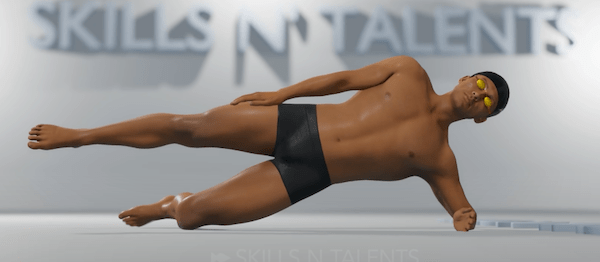
A strong core is essential, especially for swimmers. Core muscles play a crucial role in aligning the body, maintaining balance, and improving overall stability in the water.

Try it out and tell us what you think!
Thank you!