How Fast you Should Move your Arms in Swimming?
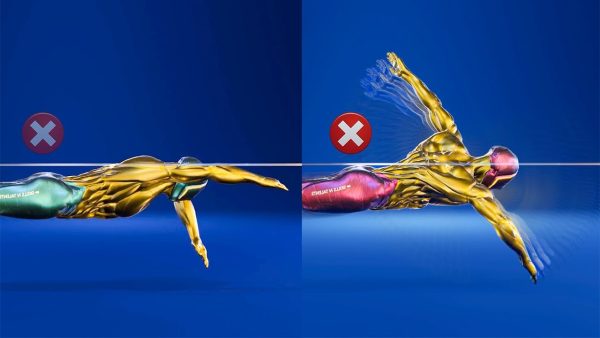
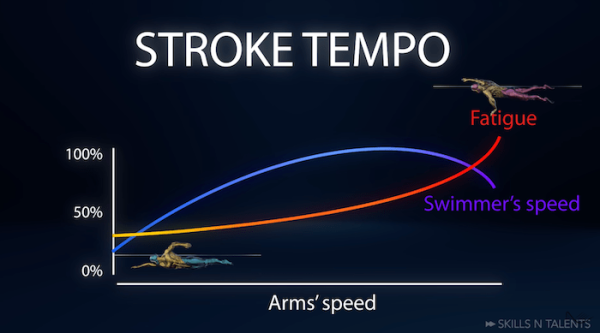
If you move your arms too slowly, your hands won’t create enough pressure to move you. If you move your arms too quickly, your technique might suffer, and your hands will not be in an optimal position to swim efficiently with each stroke.
So, what is the perfect speed for your arms to move? Should you move your arms as slowly and efficiently as possible or as fast as your technique can handle it? To find the answer, we need to know your swimming goal.
Do you swim to lose weight? Or do you swim to win an open water competition? Maybe your specialty is swimming the 100-meter freestyle. Perhaps you just want to see who is faster among your friends.
If you just want to see who is faster among your friends in one length of the pool, then yeah, you should just spin your arms as fast as possible, try to keep a good swimming technique, hold your breath, and hope for the best.
Define Your Goals
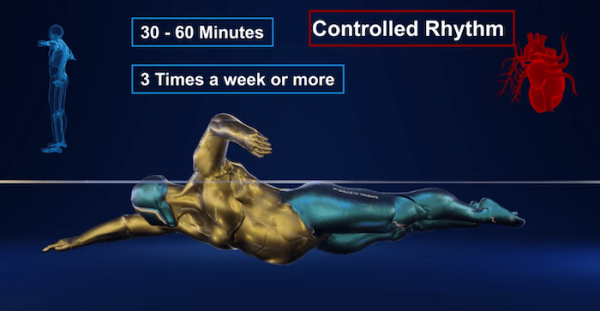
If you are trying to lose weight, then we know that slow and steady is the best option for you. Control your rhythm and swim as far as you can; studies recommend between 30 to 60 minutes (or more) at least 3 times a week. If you need to stop every 3 minutes to rest, then you are probably going too fast. So slow your arms down.
Building muscle through resistance training also helps burn more calories throughout the day, and this burns more fat.
If your goal, however, is to swim as fast as possible for a certain distance, then you need to know about the next curve.
On the X-axis, we have the distance, and on the Y-axis, we have the optimal speed of your arms expressed in cycles per second.
The pink curve is roughly distance-superstar Katie Ledecky’s best arm speed on each length. The yellow one is sprinter-superstar Sarah Sjöström’s best arm speed on each length. The white and blue are other Olympians.
These are the best swimmers in the world, and they vary greatly, so chances are your curve will be even more different from your swimming friends.
But we know two things from this curve that apply to you.
- The shorter the swimming distance, the faster you should move your arms.
- The best arm speed is not the same for everyone.

Your Optimal Arm Stroke Speed
Here is a rough way to find YOUR optimal arm stroke speed.
For Sprinter distances:
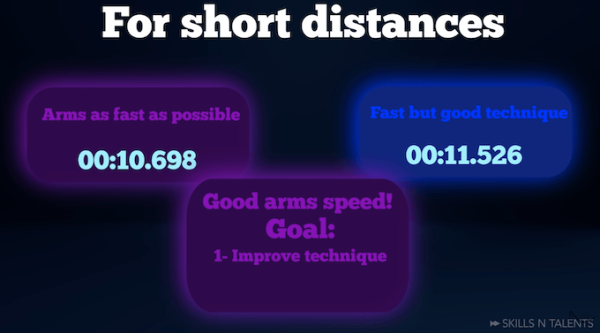
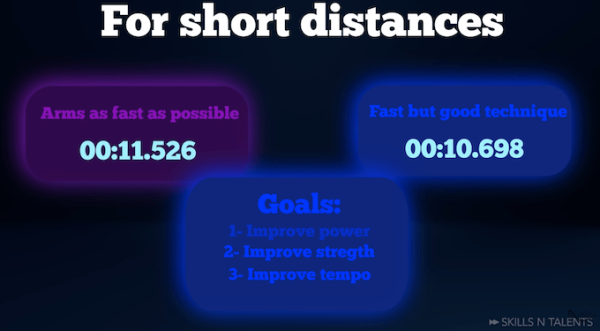
- Swim a 25 freestyle, moving your arms as fast as you can and write your time.
- Then do the same, but swim fast with the best swimming technique and write your time.
If your time was faster in the first round with the “As fast as possible” technique, then that is roughly your optimal arm speed, and now your goal is to improve your technique while sprinting so you can swim faster.
If your time was faster in the second round with the “best fast technique,” then you need to improve your power and strength and get closer to that other stroke tempo from the first 25.
For long distances:
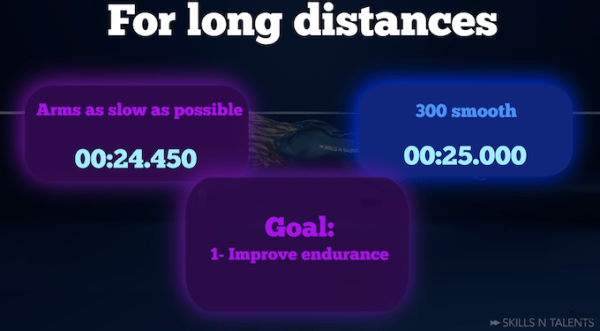
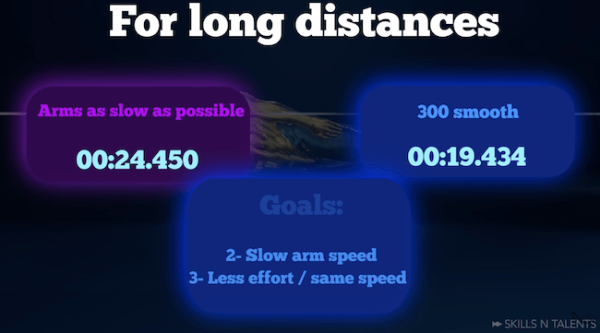
- Swim a 25 freestyle as slowly as possible while keeping a perfect technique and writing your time.
- Now swim a 300 freestyle smooth and have someone time your last 25.
If your time was faster in the first 25 with the “perfect technique,” then you need to improve your endurance.
If your time was a lot faster in the last 25 of the 300, then you might need to improve your technique, so you can slow the speed of the arms and move with less effort but at the same speed.
If you really want to get super specific, you can start creating your own curve.
Do this for each distance pace: Count the number of strokes you do in 10 seconds, divide it by 2 to get the stroke cycles, and then divide it by 10 to get the cycles per second that you do on each pace.
It’s not all about the speed of the arms, though; your swimming technique might also be different depending on the distance you are swimming.
Shortness of Breath When Breathing
It affects almost all functions of the body and mind. Our bodies think that swimming is a very high risk because we do not have access to immediate breathing. The feeling of wanting to breathe a lot is the way in which the body forces us to never lack oxygen.
The problem with hyperventilation is that while it increases the oxygen level in the blood, it decreases the oxygen levels in the muscles and brain. As we said, breathing a lot reduces carbon dioxide.

With too little carbon dioxide in the blood, blood vessels constrict and red blood cells retain oxygen instead of delivering it to the brain and muscles.
This discovery was called the Bohr effect. Here you will discover the three best exercises you can do to increase your CO2 tolerance. These were the hardest 25 meters of my life.
Improve your CO2 Tolerance
Unless you have excellent CO2 tolerance or you know the exercises, you will need a few months to complete this test.
E25 TEST is based on the teachings of Olympic athlete’s breathing coach, Patrick Mckeown. It consists of exhaling completely before starting the swim. Swim 25 meters without breathing, the challenge ends 10 seconds after touching the wall. Breathing through the nose is only allowed during those 10 seconds after the swim.
We will mention the security measures for the three exercises. But keep in mind that these exercises are not comfortable, especially in the first 2 weeks.

Respiratory Fitness
Respiratory fitness is important in helping you swim faster and with less effort. That’s why professional swimmers experiment with breathing techniques all the time; it’s part of their training.
A good example is Caeleb Dressel holding his breath in the last 10 to 15 meters before winning Olympic gold medals and breaking world records. Many of the winners do not seem breathless after they finish; they have developed a high tolerance for CO2 and also because their body is adapted to be more efficient at using oxygen.

Now, how dangerous is this? The body has three ways of preventing you from drowning.
- Warning High CO2: the chemoreceptors send out an alarm signal that makes you want to breathe.
- Spasms: It makes the breathing muscles spasm to force a breath.
- Unconscious Breathing: your body will continue to consume oxygen to the point of blackout so that it can start breathing unconsciously without you stopping it.
Shallow Water Blackout happens when you prevent those three solutions from happening. The worst and most dangerous thing you can do is hyperventilate before holding your breath underwater. You should never do this for two reasons;
- If you lower your carbon dioxide level, your brain won’t perceive the danger until it’s too late.
- Hyperventilation also reduces circulation and oxygenation to the brain.
This can cause you to lose consciousness without warning. Since you’re underwater, your body will automatically start inhaling water if you pass out.

Minimise Risks
Having no tolerance for CO2 makes exercise more difficult, increases the rate and volume of breathing, and increases the chances of chronic stress.
Not having tolerance to CO2 increases obesity, stress, and insomnia. Those three things kill far more modern humans than shallow water blackouts. But we don’t want shallow water blackouts, either.
To minimize risk, there are three golden rules for breath hold training underwater:
- People at risk should avoid strong breath holds, but can still practice very light holds and enjoy swimming and its many benefits.
- Never, never, never hyperventilate before holding your breath underwater.
- Permission of a certified lifeguard: we will never hold our breath beyond the body’s second warning, diaphragm, or neck spasms. In fact, after holding your breath, you should always be able to breathe comfortably through your nose.

Best Exercises
It is more important to gradually and steadily increase your CO2 tolerance than to push it too hard during these exercises.
EXERCISE 1
The first exercise is to build up the E25. Exhale and swim until you feel slight discomfort. Note that swimming without air is much more difficult than with full lungs. Stop when you feel the need to breathe. Try to breathe through your nose from the first inhalation.
To keep the water that drains from your face out of your nose, it is necessary to inhale very slowly. In my experience, I increased my tolerance by a meter each week, feeling calm after each attempt. Results will vary from person to person. The goal is to do the Exhaled 25.
EXERCISE 2
It is called nasal 25s. It consists of swimming 25 meters of fast freestyle at 80 to 90% of your maximum speed. Resting only 10 nasal breaths and start the next 25 fast. The exercise ends when you can no longer breathe through your nose when you slow down significantly or if you have to rest for more than 10 nasal breaths. While swimming, of course, you should breathe through your mouth.
This is probably the most difficult and important exercise.

But why is this exercise so important? Breathing through the nose reduces airflow by about 50%. Is not a bad thing. Nose breathing has four benefits:
- Nitric oxide – redistributes blood through the lungs, opens the airways, and sterilizes incoming air, which is a good thing, mainly found in the nose.
- Increases CO2 in the blood – allows the body to use the nitric oxide and carbon dioxide in the blood to expand the blood vessels. Resulting in a 10 to 20% higher oxygen consumption in the blood.
- Enough time to use oxygen – People are shocked when I tell them to hold their breath while swimming. It takes longer than you think to use all the oxygen in your lungs.
- Cleaner, warmer and more humid air. – Your nose will warm the air before it enters your lungs, and the air will be more humid.
Breathing through the mouth will dry out the airways, dehydrate the body faster, and is bad for dental hygiene. We are made to breathe through the nose. Probably the only reason we should breathe through our mouths is during swimming and extremely intense exercise.

Recommendations
Sleep and breathing experts recommended placing a small piece of tape over your mouth to prevent mouth breathing. The first time I used this I slept through the night without waking up and without a dry mouth! Breathing through your mouth at any time of the day affects your health and recovery.
After six months of doing the exercises, you will finally master the E25. Swimming can change your life, and you will be so happy with your progress.
Do one stroke to kick to the other side and take another quick breath, you don’t need to swim to the other side of the pool. You can do a few meters like this and stop.
Repetition of these drills is important because we naturally tend to go back to our legs sinking and our breathing patterns messed up.
Even the best swimmers in the world still do balance drills and breathing techniques very often.
The Best Technique to Swim Easier
Aaron sees Blake across the pool and is confused. He knows that Blake completed an Ironman with a very good time in the swim.
So he asked, what is the best technique then to swim 3.8 km easier? Kick a lot or kick a little?
The ideal way would be to kick a little, but it depends on many things. If you want to maintain a style that allows you to kick a little, you need to perfect the kick.
The more control you have over your kick, the better you’ll be able to use it to accelerate and break away from the group. This will also help you position yourself to draft off someone effectively or to warm up the legs at the end before getting on the bike.

If I wanted to swim at that speed for 3.8 kilometers, I would have to train a lot. If I were to swim that now, I would rather use at least three kicks per stroke.
Two kicks just to keep the legs up and one to help the arm pull. The number of kicks per stroke will depend on each person and the different phases of the race.
The two most important things are being in control of what your legs do and the timing.
You could keep going, but it’s better to take time to internalize what you’ve learned today before moving on. In the next blog, we’ll explore how to create that connection between your kick and your stroke.
The Good Results
Cracking your bones isn’t harmful if done safely, and swimming is one of the best ways to keep your joints healthy and strong. Share your experiences and let me know how swimming has helped you!
So tell your friends to go swimming. And so that you know you can strengthen your joints.
The Legacy of Katie Ledecky
Katie Ledecky is only 27 years old. She has the 17 best times in the history of the 1500 and the 16 best times in 800 freestyle. The only other event where this happens is Sarah Sjostrom’s 50 butterfly, where she owns the 22 best times. But this isn’t an Olympic event, sadly. If Ledecky wins four more medals like she is expected to, she will become the female swimmer with the most Olympic medals in history, ahead of Jenny Thomson, Dara Torres, and Natalie Coughlin, giving her the undisputed title of Greatest Female Swimmer of All Time. And I doubt she will retire before her home Olympic Games in LA 2028.
Let me know if this is helpful for you! I’d love to hear your feedback.
Thank you!